Primal Grow Pro Official Website › Blog › Four Supports, Seven Names
Primal Grow Pro Ingredients: Which Of The Seven Names Carries Which Claim
The Primal Grow Pro ingredients are seven named botanicals and nutrients: ginkgo biloba, bacopa monnieri, L-carnitine, L-glutamine, vinpocetine, St. John’s wort and huperzine. The label prints no amount for any of them. This post maps each name to the four supports the seller lists, which are everyday male vitality, circulation, energy and mental sharpness, so you can see which ingredient has to carry which claim before you buy.
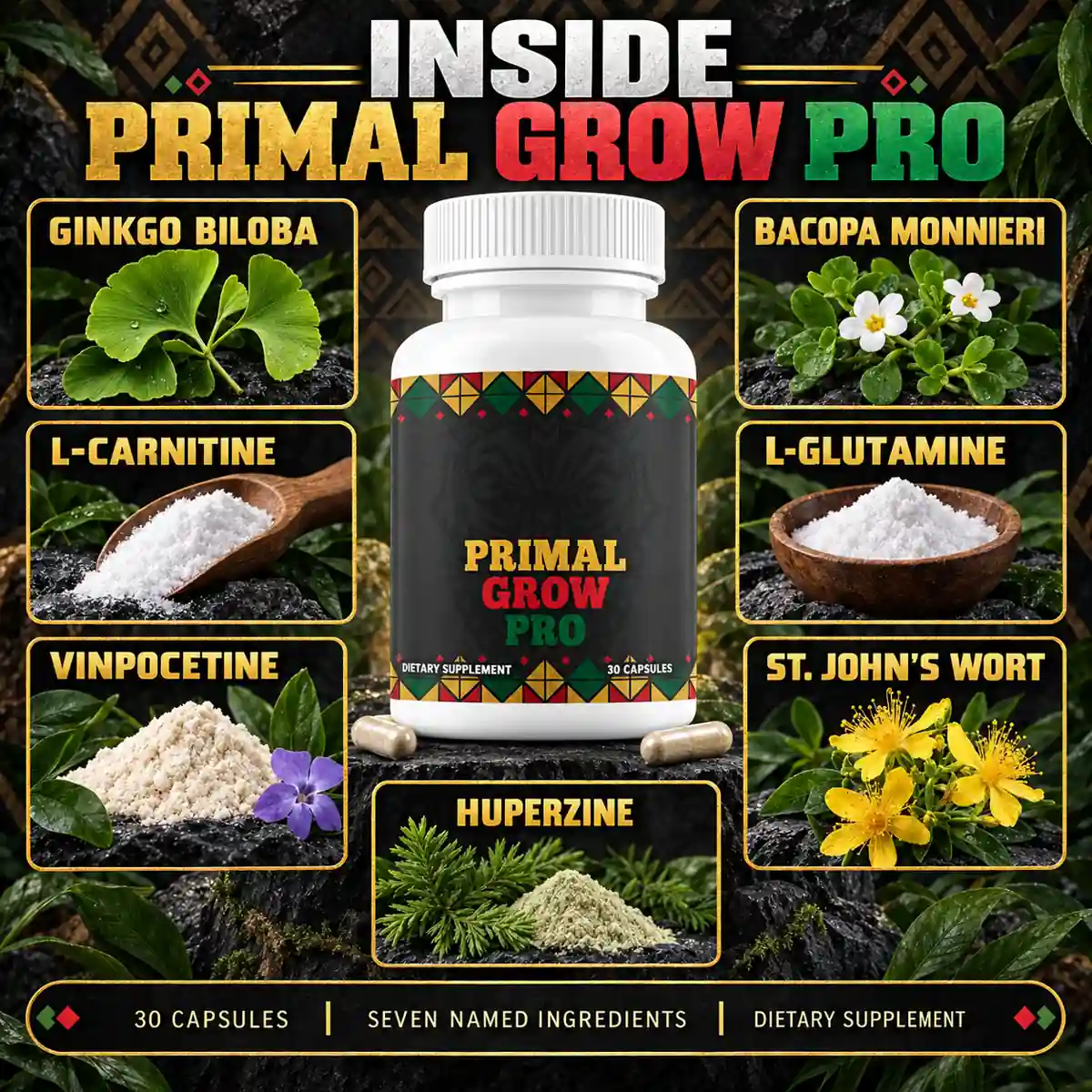
- The seller names four supports: everyday male vitality, circulation, energy and mental sharpness.
- Seven ingredients have to carry those four between them, and the mapping is checkable even though the amounts are not.
- Circulation rests on ginkgo alone. Energy rests on two amino compounds studied in grams.
- Mental sharpness holds three ingredients and the largest evidence base on the label, and it is the support the marketing mentions last.
- Two of the seven sit under none of the four.
Why the usual comparison is unavailable
The standard way to assess a supplement label is arithmetic. Find the amount printed against an ingredient, find the amount its published trials used, and put the two beside each other. Where they match, the ingredient is at least plausibly doing what the bottle implies. Where the label figure is a tenth of the trial figure, it is decoration.
That method needs a printed figure and this label has none. The front carries the wordmark, “DIETARY SUPPLEMENT”, “30 CAPSULES” and a geometric band. The supplied ingredient artwork names seven botanicals and amino compounds without a milligram anywhere. The seller’s own page repeats the names and adds nothing numerical.
A second thing goes with that absence. A printed panel lists ingredients in descending order of weight, so even without amounts it tells you which one dominates. With no panel there is no ordering rule, and the sequence on the artwork cannot be read as a ranking.
So two kinds of arithmetic are unavailable. What remains is a different question, and it turns out to be more useful than people expect.
The four supports and the names behind them
A supplement may describe an effect on the ordinary structure or function of the body. That is what a support claim is, and work on how those claims are substantiated shows how much rests on the wording and on the population being described.
This seller names four: everyday male vitality, circulation, energy and mental sharpness. Four sentences, seven ingredients, and the interesting question is which ingredient is standing behind which sentence.
| The support the seller names | The ingredients that have to carry it | What the human research on those names is actually about |
|---|---|---|
| Everyday male vitality | Ginkgo Biloba, L-Carnitine | Two names with human trials in this territory. The carnitine trial gave two grams a day of one form of it beside a prescription tablet; the ginkgo trials are about sexual function during antidepressant treatment. Neither tested a blend. |
| Circulation | Ginkgo Biloba | The best-evidenced support on the label and the only one with a trial that measured a physical outcome: pain-free walking distance in narrowed leg arteries. The review of those trials found no meaningful improvement. |
| Energy | L-Carnitine, L-Glutamine | Both are ordinary dietary amino compounds rather than stimulants, and both are studied at intakes measured in grams. Nothing here works the way a coffee does, and the label does not suggest it. |
| Mental sharpness | Bacopa Monnieri, Huperzine, Vinpocetine | The largest evidence base on this label by some distance, and the furthest from the front of the bottle. Bacopa's trials run twelve weeks before they measure anything; huperzine's are measured in micrograms. |
The middle column follows the published human literature rather than the seller’s description, which is the whole point of doing it this way.
Read down the middle column and the shape of the formula appears immediately. Ginkgo appears twice and is alone in one row. The two amino compounds share a row. And the fourth row, the one the sales copy mentions last, carries three ingredients and the largest body of published human evidence on the label.
Circulation rests on one ingredient
Of the four supports, circulation has the cleanest answer: ginkgo biloba leaf extract, on its own. No other name on this list has a circulatory literature.
It is also the most thoroughly studied thing in this capsule. The standardised extracts used in research are specified by two marker groups and trialled at 120 to 240 mg a day, which is a reproducible preparation rather than a vague botanical.
The circulation evidence points in an awkward direction, and a page that skipped it would be the kind of page nobody should trust. The Cochrane review of ginkgo in intermittent claudication pooled randomised trials of pain-free walking distance in people whose leg arteries were narrowed enough to limit how far they could walk. That is about as physical and as demanding a circulatory endpoint as a botanical ever gets held to. The pooled result showed no meaningful advantage over placebo.
Nearer this product the record is friendlier. A systematic review of ginkgo and sexual function collects the human trials in that area, a literature most ingredients on this shelf do not have at all. Small, mixed, and real. So the honest statement about circulation here is: one ingredient, well studied, whose hardest test came back negative and whose softer tests came back mixed.
Energy means substrate, not stimulation
The energy row is the one most likely to be misread, and the misreading is understandable. Most products that use the word contain a stimulant. This one does not: there is no caffeine on this label and nothing else that acts like it.
Energy here is L-carnitine and L-glutamine. Carnitine transports long-chain fatty acids into the mitochondria, which is the step before they can be burned for fuel. Glutamine is the most abundant free amino acid in human plasma and a fuel source for gut lining cells and immune cells. Both are present in ordinary food in quantity.
Their trial literature works at a scale a capsule cannot reach. The carnitine trial closest to this product’s territory used two grams a day of propionyl-L-carnitine, alongside prescription sildenafil, in men with diabetes. Two grams is two thousand milligrams of one ingredient. The glutamine tolerance study in healthy adults dosed per kilogram of body weight, in grams, which for an average adult puts a studied serving in the tens of grams.
What follows is arithmetic rather than opinion. A capsule holds under a gram of powder in total and this one holds seven things, so neither amino compound can be at the amount its own research used. That does not make the row dishonest: both are safe and genuinely involved in energy metabolism, and the seller says “supports” rather than “provides”. It does mean that anyone expecting an afternoon lift from this row is expecting the wrong thing.
- No stimulant anywhere on this label, so nothing here acts within the hour.
- Both amino compounds occur in food, and a substantial meal supplies more than a capsule can.
- Studied in grams, which is the scale that makes the arithmetic decisive.
- Safe and well tolerated, which is a separate question from whether they are present in a meaningful amount.
Read the ingredient list, then decide about Primal Grow Pro
Seven names printed openly, one capsule a day with a meal, and sixty days from purchase to change your mind, opened bottles included.
One bottle $69 · four bottles $196 · 60-day money-back guarantee
Order Primal Grow Pro On The Official WebsiteOne capsule a day · 30 per bottle · lot PRI-26/PR-3833
The support with the most evidence is named last
Mental sharpness is the fourth support on the sales page and the one carrying the heaviest evidence in the bottle. Three ingredients sit under it.
Bacopa monnieri is the best of them. The meta-analysis of its randomised trials finds a consistent improvement in the speed of attention tasks at 300 mg a day of a standardised extract. The number to carry away is not the dose but the duration: those trials waited twelve weeks before measuring anything.
Huperzine is the most pharmacologically direct thing on the label. It inhibits acetylcholinesterase, the same enzyme a class of prescription dementia medicines acts on, and the meta-analysis of its trials reports improvements on cognitive scales at a few hundred micrograms a day. It is the one ingredient here whose studied amount a single capsule could hold comfortably.
Vinpocetine is the odd one out and is covered in the next section. Put together, this is a respectable cognitive ingredient list sitting inside a product whose front label leads with vitality and circulation, and a buyer who wanted that fourth support specifically is better served knowing it than reading the front of the bottle.
Two names under nothing at all
Two of the seven ingredients sit under none of the four supports the seller names, and setting the whole list out in one table makes that visible in a way a paragraph does not.
| Ingredient | Where its human trials actually sit | Which support it is under |
|---|---|---|
| Vinpocetine | Hospital neurology, chiefly acute ischaemic stroke | None of the four |
| St. John’s wort | Major depression, at 900 mg a day | None of the four |
| Ginkgo biloba | Circulation, cognition and sexual function | Circulation, and part of everyday male vitality |
| Bacopa monnieri | Cognition, over twelve weeks | Mental sharpness |
| L-carnitine | Male fertility, and one trial alongside a prescription tablet | Energy, and part of everyday male vitality |
| L-glutamine | Nutritional and clinical support, dosed per kilogram | Energy |
| Huperzine | Cognition, in micrograms | Mental sharpness |
Two of the seven sit under nothing the seller names. That is an observation about how the formula is assembled, not an accusation.
Vinpocetine is synthesised in a laboratory from vincamine, an alkaloid from lesser periwinkle, and its clinical literature sits in hospital neurology. St. John’s wort is a mood herb whose trial record is in depression at 900 mg a day; its presence here matters for a reason unconnected to the four supports, which is what it does to the clearance of prescription medicines. The side effects page covers that at length.
Neither is an accusation. A seven-ingredient formula naming four supports will usually have ingredients doing something the marketing does not mention, and a buyer is better off seeing which.
How to run this on any bottle
- Write down the claims from the front of the bottle. Usually three to five.
- Write down every ingredient name. If they are pooled into a blend name with one total weight, stop: this method cannot be run on that label, and that is the finding.
- For each claim, list the names that could carry it. Not what the marketing says; what the published human literature on that ingredient is about.
- Notice the claims with one name behind them. Those are the fragile ones.
- Notice the names under no claim at all. Something put them in the capsule.
Applied here it produces four findings in five minutes: circulation rests on one ingredient, energy is substrate rather than stimulation, the best-evidenced support is mentioned last, and two names are doing something nobody has explained. A 2026 framework for ingredient-interpretation gaps sets out the distance between what a shopper reads into a name and what the evidence behind it supports. A name on a label sits in that gap, and tracing it to a claim is the cheapest way to close it.
None of this tells you whether the capsule works. It tells you which ingredient stands behind which promise, which is smaller and checkable. The strength of the blend stays unknown, as the ingredients page says plainly.
References
- Nicolaï SP, Kruidenier LM, Bendermacher BL, et al. Ginkgo biloba for intermittent claudication. Cochrane Database Syst Rev. 2013;2013(6):CD006888. PMID 23744597. https://pubmed.ncbi.nlm.nih.gov/23744597/
- Niazi Mashhadi Z, Irani M, Kiyani Mask M, et al. A systematic review of clinical trials on Ginkgo (Ginkgo biloba) effectiveness on sexual function and its safety. Avicenna J Phytomed. 2021;11(4):324-331. PMID 34290964. https://pubmed.ncbi.nlm.nih.gov/34290964/
- Gentile V, Vicini P, Prigiotti G, et al. Preliminary observations on the use of propionyl-L-carnitine in combination with sildenafil in patients with erectile dysfunction and diabetes. Curr Med Res Opin. 2004;20(9):1377-84. PMID 15383186. https://pubmed.ncbi.nlm.nih.gov/15383186/
- Ogden HB, Child RB, Fallowfield JL, et al. Gastrointestinal tolerance of low, medium and high dose acute oral L-glutamine supplementation in healthy adults: a pilot study. Nutrients. 2020;12(10). PMID 32992440. https://pubmed.ncbi.nlm.nih.gov/32992440/
- Kongkeaw C, Dilokthornsakul P, Thanarangsarit P, et al. Meta-analysis of randomized controlled trials on cognitive effects of Bacopa monnieri extract. J Ethnopharmacol. 2014;151(1):528-35. PMID 24252493. https://pubmed.ncbi.nlm.nih.gov/24252493/
- Yang G, Wang Y, Tian J, et al. Huperzine A for Alzheimer's disease: a systematic review and meta-analysis of randomized clinical trials. PLoS One. 2013;8(9):e74916. PMID 24086396. https://pubmed.ncbi.nlm.nih.gov/24086396/
- Evans M, Lewis ED, Antony JM, et al. Revisiting the definition of 'healthy' participants in substantiation of structure/function claims for dietary supplements. J Diet Suppl. 2025;22(1):41-57. PMID 38298107. https://pubmed.ncbi.nlm.nih.gov/38298107/
- Alsawadi A. The perception filler: a proposed conceptual framework for ingredient-interpretation gaps in food supplements. J Nutr. 2026;156(10):101803. PMID 42660500. https://pubmed.ncbi.nlm.nih.gov/42660500/