Primal Grow Pro Official Website › Male Vitality Guide
Male Vitality GuideMale Vitality Supplements: What Is Actually On The Shelf
The male vitality category is built from a surprisingly small pool of ingredients.
The same twenty or so names recur across hundreds of products, their published evidence is very unevenly distributed, and the front-of-bottle wording is near-identical across the shelf. This guide sets out what is in that pool, what the research on it shows and what a supplement may legally claim.
Written about the category rather than about any one bottle, including the one this website sells.
What the category is for
No condition, no outcome measure, and that shapes everything else.
“Male vitality” is a marketing category rather than a clinical one, and that is worth saying at the outset because it explains most of what follows. There is no condition called low vitality and no test for it. What the category addresses is a cluster of ordinary age-related changes: energy that runs out earlier in the day, physical capacity that has narrowed, sleep that is less restorative, and a general sense that things which used to be automatic now take effort.
Because there is no defined condition, there is no defined outcome measure, and because there is no outcome measure, the trial literature is scattered across whatever adjacent endpoints researchers could actually measure: erectile function, semen parameters, walking distance, cognitive test scores, fatigue scales. That scattering is the single most important thing to understand about the evidence in this category.
It also explains why the claims on the front of these bottles are worded so carefully. A supplement may describe an effect on ordinary structure or function and may go no further, and work on how those claims are substantiated shows how much rests on the population a claim is about.
The ingredients that recur, and what their evidence shows
Seven groups, and between them they account for most of what is on this shelf.
| Ingredient | What it is | What the human evidence actually shows |
|---|---|---|
| Ginkgo biloba | Standardised leaf extract | Studied at 120 to 240 mg a day. The circulation trials found no meaningful gain in walking distance; the sexual-function review collects a smaller, friendlier literature. Real interaction record with antiplatelet medicines. |
| L-carnitine | An amino compound, also in red meat | One trial at two grams a day of a particular form alongside a prescription tablet, plus a meta-analysis in male infertility. Studied in grams, not milligrams. |
| L-arginine and L-citrulline | Amino acids in the nitric oxide pathway | The best-supported single-ingredient group in this category, and studied at multiple grams a day. The network meta-analysis puts the effect sizes in context. |
| Zinc | An essential mineral | Matters when somebody is deficient and does much less when they are not, which is the general shape of mineral supplementation. |
| Tribulus, maca, fenugreek | Botanicals with large reputations | Reputation consistently outruns the trial data. The evidence review of popular ingredients is the clearest single source on this. |
| Bacopa, huperzine, vinpocetine | Cognitive ingredients | Appear in blends sold for vitality despite acting on cognition. Bacopa has a pooled trial literature at 300 mg a day over twelve weeks; huperzine is measured in micrograms. |
| Herbal extracts sold as testosterone boosters | Various | The category’s weakest evidence and its loudest claims. No dietary supplement may claim to treat a hormonal condition. |
This table describes the category. The seven names in the product this website sells are set out on its own ingredients page.
Two patterns run through that table. The first is scale: the ingredients with the best human evidence in this category are studied at intakes measured in grams, and a capsule holds under a gram in total. The second is adjacency: a great many ingredients here have evidence in something near the category rather than in the category itself.
What a supplement may claim, and what it may not
Five kinds of claim, and two of them are all a bottle may carry.
| Kind of claim | Example | Allowed? |
|---|---|---|
| Structure-function | “Supports circulation” | Yes, with the required FDA statement alongside it. |
| Nutrient content | “An excellent source of zinc” | Yes, against defined thresholds. |
| Disease | “Treats erectile dysfunction” | No. |
| Hormonal | “Raises testosterone” | No, as a claim to treat a condition. |
| Anatomical | “Increases size” | No. The systematic review of enhancement interventions covers devices and surgery, and no oral supplement reaches that literature. |
The first two are the whole of what a bottle in this category may say on its front.
The practical use of that table is as a filter. A product page making any of the bottom three claims has told you something about how carefully it is run, whatever is in the bottle. That is a cheap and reliable signal and it costs nothing to apply.
The adulteration problem, and what to do about it
The problem in this category that has nothing to do with whether the ingredients work.
This is the part of the category most buyers do not know about, and it is the most consequential.
Products sold as natural sexual enhancers have repeatedly been found to contain undeclared prescription drugs. A screen of the category and a 2025 quantification study both found sildenafil or tadalafil in products whose labels named neither. That is not a theoretical risk: those are real medicines with real contraindications, and somebody taking a nitrate for heart disease has a serious problem if their herbal capsule contains one.
An analysis of popular online erectile dysfunction supplements makes the wider point about what is actually being sold in this category online.
The practical defences are unglamorous and they work. Buy through a seller with a named desk and a return address rather than through a marketplace listing. Be suspicious of anything that produces a same-day effect, because botanicals do not. And treat a bottle making a disease claim as a bottle whose contents have not been thought about carefully.
How long anything in this category takes
Weeks to months, and the gap between that and what people expect is where most disappointment comes from.
Longer than almost anybody expects, and the expectation gap is the commonest reason people conclude a product did nothing.
Botanical ingredients with human evidence behind them generally show it after weeks of daily use. Bacopa's twelve-week trial did not measure earlier because there was nothing to measure earlier. Ginkgo's largest trial ran for six years. Amino acids studied at gram doses act faster but are not usually present at those doses in a capsule.
What that means practically is that any fair trial in this category is measured in months rather than weeks, and that a refund window shorter than the trial is a window you cannot really use. Sixty days including opened bottles is at the generous end of what this shelf offers, and thirty days unopened-only is functionally nothing.
It also means that the first bottle of anything is a trial of the habit rather than of the formula. Most supplement trials end in week three, and they end for reasons that have nothing to do with the ingredients.
What to do before buying anything in this category
Six habits, all of them free, and between them they sort most of this shelf.
- Read the ingredient list before the front of the bottle. The front is written by a marketing department; the list is written by a formulator.
- Check whether amounts are printed, and if they are, compare them with what the trials used. If they are not, at least know which names you are taking.
- Look for anything on the list with an interaction record. St. John’s wort and ginkgo both have one, and both appear in this category.
- Read the refund window properly: its length, what it counts from and whether opened bottles are covered.
- Check there is a telephone number and a return address, not just a form.
- Plan two months, not two weeks, and write down what you actually want to change before you start.
The checklist turns those six into eight scored points and applies them to the product this website sells, including the two it fails.
Blends against single ingredients
Why almost every product here is a blend, and what that costs in what can be known.
Almost everything on this shelf is a blend of five to fifteen names, and almost all the published evidence is on single ingredients. That mismatch is structural rather than accidental, and understanding it changes how a label should be read.
The commercial reason for a blend is straightforward. A long ingredient list looks comprehensive, it covers several plausible mechanisms at once, and it makes direct comparison with a competitor difficult. The formulation reason is that nobody knows which of these ingredients matters, so covering several is a hedge.
The cost is arithmetic. A capsule holds under a gram of powder. A blend of seven names cannot hold seven studied doses, and a blend of fifteen certainly cannot. Something has to be present in a token amount, and without printed figures nobody outside the manufacturer knows which.
The second cost is evidential. No blend in this category has been trialled as a blend, so every claim rests on ingredient-level evidence that does not transfer. A trial of two grams of one amino compound says nothing about a capsule containing an unstated fraction of it alongside six other things.
None of this makes blends useless. It makes them unverifiable at the level most buyers assume they are verifying, and it is why the checklist in the companion guide leads with whether the names and the amounts are printed rather than with what the front of the bottle promises.
Who publishes this Primal Grow Pro website?
- Nicolaï SP, Kruidenier LM, Bendermacher BL, et al. Ginkgo biloba for intermittent claudication. Cochrane Database Syst Rev. 2013;2013(6):CD006888. PMID 23744597. https://pubmed.ncbi.nlm.nih.gov/23744597/
- Niazi Mashhadi Z, Irani M, Kiyani Mask M, et al. A systematic review of clinical trials on Ginkgo (Ginkgo biloba) effectiveness on sexual function and its safety. Avicenna J Phytomed. 2021;11(4):324-331. PMID 34290964. https://pubmed.ncbi.nlm.nih.gov/34290964/
- DeKosky ST, Williamson JD, Fitzpatrick AL, et al. Ginkgo biloba for prevention of dementia: a randomized controlled trial. JAMA. 2008;300(19):2253-62. PMID 19017911. https://pubmed.ncbi.nlm.nih.gov/19017911/
- Gentile V, Vicini P, Prigiotti G, et al. Preliminary observations on the use of propionyl-L-carnitine in combination with sildenafil in patients with erectile dysfunction and diabetes. Curr Med Res Opin. 2004;20(9):1377-84. PMID 15383186. https://pubmed.ncbi.nlm.nih.gov/15383186/
- Sharma AP, Sharma G, Kumar R. Systematic review and meta-analysis on effect of carnitine, coenzyme Q10 and selenium on pregnancy and semen parameters in couples with idiopathic male infertility. Urology. 2022;161:4-11. PMID 34871624. https://pubmed.ncbi.nlm.nih.gov/34871624/
- Barbonetti A, Tienforti D, Antolini F, et al. Nutraceutical interventions for erectile dysfunction: a systematic review and network meta-analysis. J Sex Med. 2024;21(11):1054-1063. PMID 39279185. https://pubmed.ncbi.nlm.nih.gov/39279185/
- Balasubramanian A, Thirumavalavan N, Srivatsav A, et al. An analysis of popular online erectile dysfunction supplements. J Sex Med. 2019;16(6):843-852. PMID 31036522. https://pubmed.ncbi.nlm.nih.gov/31036522/
- Kuchakulla M, Narasimman M, Soni Y, et al. A systematic review and evidence-based analysis of ingredients in popular male testosterone and erectile dysfunction supplements. Int J Impot Res. 2021;33(3):311-317. PMID 32358510. https://pubmed.ncbi.nlm.nih.gov/32358510/
- Kongkeaw C, Dilokthornsakul P, Thanarangsarit P, et al. Meta-analysis of randomized controlled trials on cognitive effects of Bacopa monnieri extract. J Ethnopharmacol. 2014;151(1):528-35. PMID 24252493. https://pubmed.ncbi.nlm.nih.gov/24252493/
- Calabrese C, Gregory WL, Leo M, et al. Effects of a standardized Bacopa monnieri extract on cognitive performance, anxiety, and depression in the elderly: a randomized, double-blind, placebo-controlled trial. J Altern Complement Med. 2008;14(6):707-13. PMID 18611150. https://pubmed.ncbi.nlm.nih.gov/18611150/
- Romero-Otero J, Manfredi C, Ralph D, et al. Non-invasive and surgical penile enhancement interventions for aesthetic or therapeutic purposes: a systematic review. BJU Int. 2021;127(3):269-291. PMID 32575166. https://pubmed.ncbi.nlm.nih.gov/32575166/
- Jairoun AA, Al-Hemyari SS, Shahwan M, et al. Screening and determination of synthetic PDE-5 inhibitors in adulterated sexual enhancement supplements. Molecules. 2022;27(19). PMID 36235271. https://pubmed.ncbi.nlm.nih.gov/36235271/
- Omeragić E, Jesenković-Habul L, Imamović B, et al. Detection and quantification of sildenafil and tadalafil in dietary supplements marketed as natural sexual enhancers in Bosnia and Herzegovina. Cent Eur J Public Health. 2025;33(3):181-186. PMID 41165181. https://pubmed.ncbi.nlm.nih.gov/41165181/
- Evans M, Lewis ED, Antony JM, et al. Revisiting the definition of 'healthy' participants in substantiation of structure/function claims for dietary supplements. J Diet Suppl. 2025;22(1):41-57. PMID 38298107. https://pubmed.ncbi.nlm.nih.gov/38298107/
- Using Dietary Supplements Wisely. National Center for Complementary and Integrative Health, National Institutes of Health. https://www.nccih.nih.gov/health/using-dietary-supplements-wisely
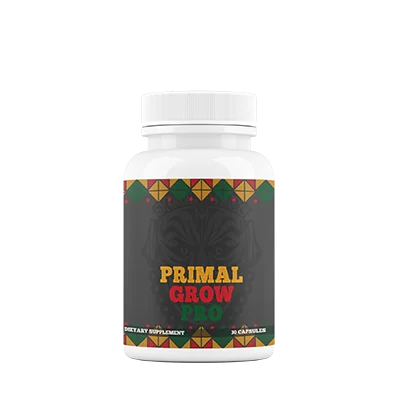
Order Primal Grow Pro on the official website
Seven named ingredients, one capsule a day, free US shipping and sixty days including opened bottles.
One bottle $69 · four bottles $196 · 60-day money-back guarantee
Order Primal Grow Pro On The Official WebsiteOne capsule a day · 30 per bottle · lot PRI-26/PR-3833