Primal Grow Pro Official Website › Blog › Huperzine Is Measured In Micrograms
Huperzine Is Measured In Micrograms, And Why That Matters Here
On a label with no amounts printed, the unit an ingredient is normally studied in is one of the few pieces of information still available. Huperzine is the only name on this bottle measured in micrograms, and that single fact changes what can be said about it.
- Huperzine A is studied at a few hundred micrograms a day. Every other ingredient on this label is studied in milligrams or grams.
- That makes it the one name here a single capsule could hold at a researched amount without difficulty.
- It inhibits acetylcholinesterase, the same mechanism as a class of prescription medicines.
- An assay of products on sale found real variation between declared and measured content.
- A small number on a label is not evidence of a token amount, and reading it that way is the commonest mistake in this category.
Why the unit is information
When a label prints no amounts, most of the usual analysis becomes impossible. What survives is knowledge about the ingredients themselves, and one of the most useful pieces of that knowledge is the unit their research works in.
An ingredient normally studied in grams cannot be present at a studied amount inside a seven-ingredient capsule, and that conclusion holds regardless of what any label says. An ingredient normally studied in micrograms is under no such constraint. Same capsule, same missing figures, opposite conclusion.
This label spans an unusually wide range, which makes it a good example.
| Ingredient | The unit its trials use | A studied daily amount |
|---|---|---|
| Huperzine A | Micrograms | A few hundred micrograms, usually split in two |
| Bacopa monnieri | Milligrams | 300 mg, and 600 mg in the measurable band |
| Ginkgo biloba | Milligrams | 120 to 240 mg |
| L-carnitine | Grams | 2 g |
| L-glutamine | Grams per kilogram | 0.3 to 0.9 g/kg |
Five ingredients on one label, spanning four orders of magnitude between the smallest studied amount and the largest.
Four orders of magnitude separate the smallest studied amount on this label from the largest. That is not a criticism of the formula. It is a reason to stop treating a seven-name ingredient list as seven equivalent things, and it is why the ingredients page prints the trial amount beside each name rather than listing them as a row of equals.
What huperzine is
Huperzine A is an alkaloid isolated from Huperzia serrata, a Chinese club moss used in traditional medicine. It is a single defined molecule rather than a plant extract standardised to a marker, which is one reason its dosing is so precise compared with the botanicals beside it on this label.
Its mechanism is the most pharmacologically direct thing in this capsule. It inhibits acetylcholinesterase, the enzyme that breaks down the neurotransmitter acetylcholine at the synapse. Less breakdown means more acetylcholine available, and that is the same mechanism a class of prescription medicines used in dementia care relies on.
That is worth pausing on. Most supplement ingredients have mechanisms described in terms of antioxidant activity or general support. This one has a named enzyme target shared with prescription pharmacology, and it is the only ingredient on this label of which that is true.
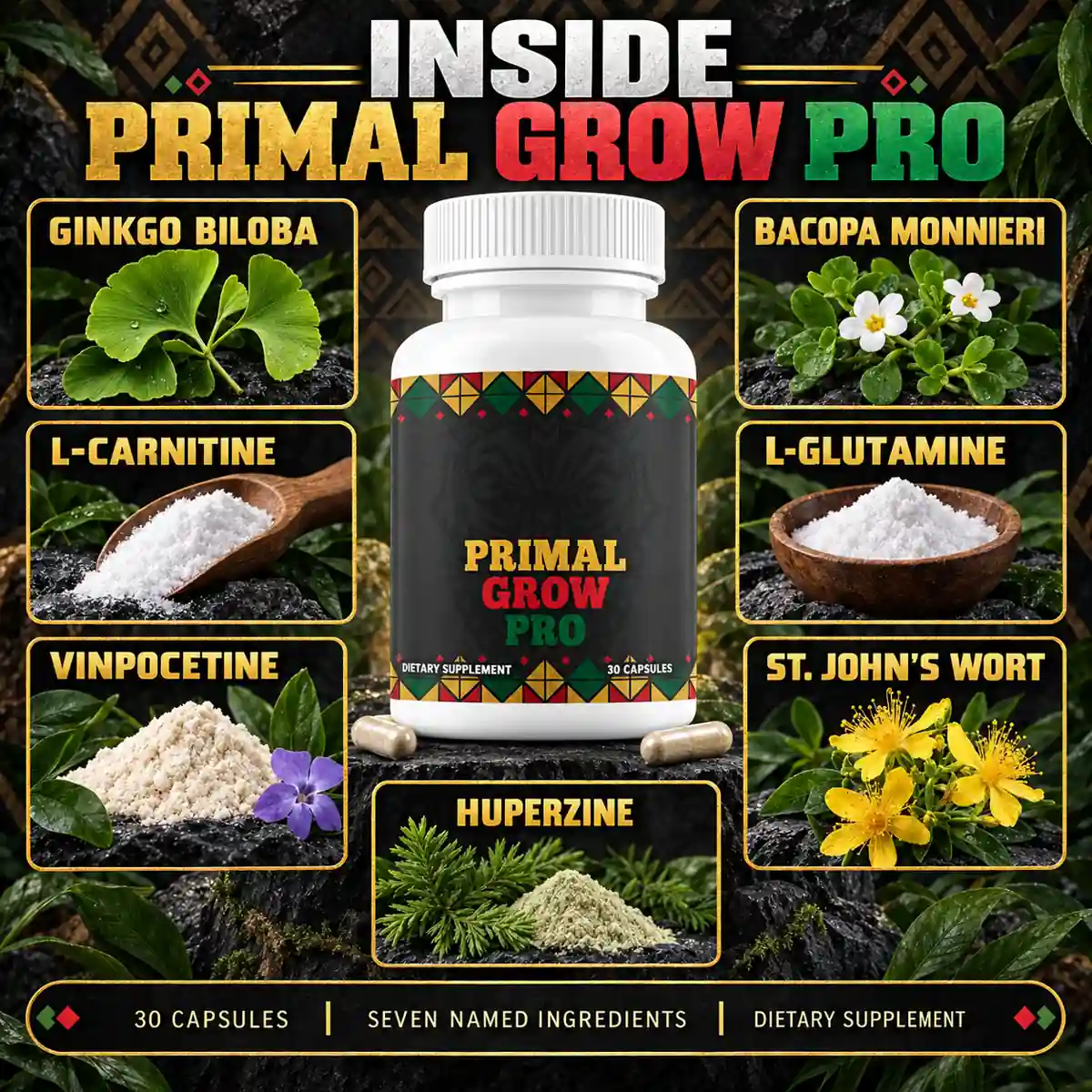
What the trials found, and what a review said about them
A meta-analysis of randomised trials of huperzine A in Alzheimer’s disease reported improvements on cognitive scales at daily amounts in the low hundreds of micrograms. On its face that is a positive result for an ingredient sold over the counter.
The Cochrane review in mild cognitive impairment is considerably more reserved, and its reservations are about the quality and the reporting of the underlying studies rather than about the direction of the findings. Both of those are true at once, and a page that quoted only one of them would be selecting rather than reporting.
The honest summary is that huperzine has more mechanistic credibility than most ingredients in this space and a trial literature whose quality has been questioned by the most careful people who have looked at it. That is a normal state of affairs for a supplement ingredient and it is worth stating plainly rather than resolving artificially.
It is also worth noting what those trials were in. They were conducted in people with a diagnosis, not in healthy adults looking for an edge, and results in the first population do not transfer to the second.
The one ingredient here a capsule could hold properly
This is the constructive half of the article and the reason the unit matters.
| What it means | For a buyer of this bottle |
|---|---|
| Huperzine could plausibly be at a studied amount here | It is the one ingredient on this label where a single capsule is no obstacle at all. |
| A small number is not automatically a token amount | Judging an ingredient by the size of its number is the commonest mistake in label reading. |
| Micrograms are hard to dose accurately | Which is why the assay literature on huperzine products matters more than usual. |
| It is pharmacologically direct | It acts on the same enzyme as a class of prescription medicines, so it belongs in a conversation with a prescriber rather than in a footnote. |
Four consequences of one unit, and the fourth is the one worth acting on.
Take the first row seriously. Three hundred micrograms is three tenths of a milligram. In a capsule holding several hundred milligrams of material, that is a rounding error by weight, which means there is no arithmetic obstacle whatsoever to huperzine being present at a fully researched amount here.
Whether it is remains unknown, because no figure is printed and no assay of this product is published. But the class of argument that rules out carnitine and glutamine does not touch huperzine at all, and a reader who applied the same reasoning to every row would get this one wrong.
The second row generalises beyond this bottle. Buyers routinely assume that a small number on a label means a token amount, and for microgram-scale ingredients that assumption is simply false. Vitamin B12, vitamin D, biotin and several minerals are all correctly dosed in micrograms.
Seven ingredients, each on its own scale
One capsule a day with a meal, thirty to a bottle, and sixty days from purchase to decide whether it belongs in your routine.
One bottle $69 · four bottles $196 · 60-day money-back guarantee
Order Primal Grow Pro On The Official WebsiteOne capsule a day · 30 per bottle · lot PRI-26/PR-3833
Why micrograms make an assay matter more
There is a genuine manufacturing consequence to dosing in micrograms, and it is the strongest practical argument in this article.
Blending a few hundred micrograms of a single molecule evenly through a batch of powder is harder than blending three hundred milligrams of a botanical extract. Small amounts are more sensitive to mixing, to static, to settling during filling. That is exactly why manufacturers use premixed dilutions for potent ingredients, and it is why content uniformity is a routine test in a well-run facility.
An assay of huperzine A products on sale found real variation between what bottles declared and what they contained. That is a finding about a market rather than about any one product, and it is a reason to prefer a seller with a lot record and a telephone number over a marketplace listing.
The same literature exists for the other laboratory-derived ingredient on this label. A survey of vinpocetine products sold in the United States measured content against declaration, and a later analysis of cognitive-enhancement supplements covered the same ground. Neither examined this product.
The batch verify page sets out what the lot code and the certificate reference on this bottle actually settle, which is provenance rather than composition.
The conversation this ingredient belongs in
One practical consequence follows from the mechanism rather than from the dose, and it is the part of this article worth acting on.
Because huperzine acts on acetylcholinesterase, taking it alongside a prescription cholinesterase inhibitor means stacking one pharmacological effect. That is not a supplement question; it is a prescriber question, and it belongs in the same conversation as the two other ingredients on this label with interaction records.
For anyone taking nothing on prescription, huperzine’s reported effects at supplement amounts are mild and cholinergic in character: nausea, sweating, vivid dreams. They are dose-related and uncommon.
The side effects page covers all of this alongside St. John’s wort and ginkgo, which are the two names on this label with the larger interaction literatures.
- Ask about it if you take a cholinesterase inhibitor. That is a specific question with a specific answer.
- Do not stack it with a second nootropic product containing huperzine. With no figures on either bottle the total cannot be worked out.
- Do not read the small unit as a small ingredient. Micrograms are the correct scale here.
- Prefer a channel with a lot record, because content uniformity is the real manufacturing question for an ingredient dosed this way.
Nothing here says huperzine is present in this capsule at a researched amount, because no figure is printed and no assay of the product exists. What it says is that, unlike two other ingredients on the same label, there is no arithmetic reason it could not be.
References
- Yang G, Wang Y, Tian J, et al. Huperzine A for Alzheimer's disease: a systematic review and meta-analysis of randomized clinical trials. PLoS One. 2013;8(9):e74916. PMID 24086396. https://pubmed.ncbi.nlm.nih.gov/24086396/
- Yue J, Dong BR, Lin X, et al. Huperzine A for mild cognitive impairment. Cochrane Database Syst Rev. 2012;12(12):CD008827. PMID 23235666. https://pubmed.ncbi.nlm.nih.gov/23235666/
- Crawford C, Wang YH, Avula B, et al. The scoop on brain health dietary supplement products containing huperzine A. Clin Toxicol (Phila). 2020;58(10):991-996. PMID 31990212. https://pubmed.ncbi.nlm.nih.gov/31990212/
- Avula B, Chittiboyina AG, Sagi S, et al. Identification and quantification of vinpocetine and picamilon in dietary supplements sold in the United States. Drug Test Anal. 2016;8(3-4):334-43. PMID 26426301. https://pubmed.ncbi.nlm.nih.gov/26426301/
- Cohen PA, Avula B, Wang YH, et al. Five unapproved drugs found in cognitive enhancement supplements. Neurol Clin Pract. 2021;11(3):e303-e307. PMID 34484905. https://pubmed.ncbi.nlm.nih.gov/34484905/