Primal Grow Pro › Blog › What A Meal Changes For Seven Ingredients
What A Meal Changes For Seven Ingredients On One Label
The directions on this label are short: one capsule a day, with a meal. They do not say why. It turns out that the seven named ingredients have very different histories with food, from one that has a properly measured meal effect to several where nobody has published the comparison at all. This article goes through them one at a time and is plain about which is which.
- The label says one capsule a day with a meal and prints no amount for any of the seven ingredients.
- Only vinpocetine has a published human comparison of fasting against fed dosing in what I found: in a small pilot, exposure was 60 to 100 percent higher with food.
- For L-carnitine the published contrast is dietary carnitine against supplement carnitine, not a capsule with or without a meal.
- For ginkgo, huperzine A, bacopa and St. John’s wort, I found pharmacokinetic or tolerability work but no fed-versus-fasted comparison.
- Glutamine is the mirror image: one study found food did not significantly change its clearance, in sickle cell disease patients and healthy adults on gram-per-kilogram doses.
What the label actually says
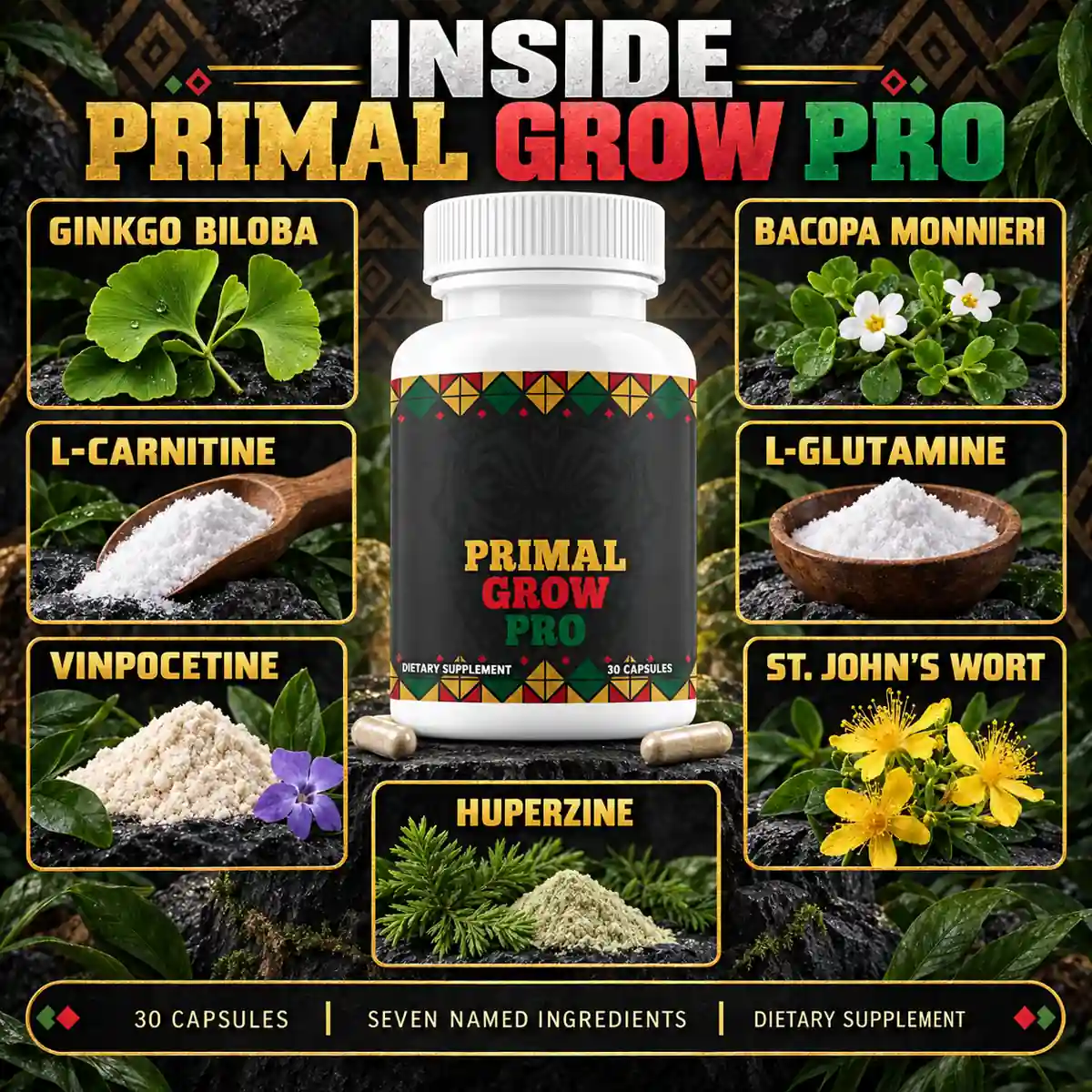
Start with what is on the bottle, because it is less than people assume. Primal Grow Pro is a capsule. The directions are one a day, taken with a meal, for adult men. The supplied ingredient artwork names seven things: Ginkgo Biloba, Bacopa Monnieri, L-Carnitine, L-Glutamine, Vinpocetine, St. John’s Wort and Huperzine. There is no milligram figure beside any of them, no extract ratio and no statement of which form of each is used.
That last omission matters more for this topic than it first appears. When a study asks what a meal does to an ingredient, it is asking about one specific preparation at one specific dose in one specific group of people. A film tablet of a drug is not a capsule of a blended botanical. So before any of the findings below, keep one limit in mind: I found no published food-effect study of this capsule, and the label gives too little to reconstruct one from the parts. What follows is what PubMed-indexed work says about each name on its own, and it is deliberately more cautious than the confident tone of most supplement copy about “taking it with food.”
The figure below is the supplied artwork for the seven names. It is a picture of a list, nothing more, and it is why this article works ingredient by ingredient.
Why a meal can matter at all
The general picture is well established, if unglamorous. A review of food–drug interactions in the journal Drugs concluded that the majority of clinically relevant food–drug interactions are caused by food-induced changes in the bioavailability of the drug (Schmidt and Dalhoff, 2002). Bioavailability just means how much of what you swallow ends up in the bloodstream and how quickly. Food can raise it, lower it, delay it or leave it alone, and which one happens is specific to the compound.
Notice what that review is about: drugs. The best-studied food effects belong to products that had to file pharmacokinetic data to be sold. Botanical ingredients and amino acids sold as supplements had no such obligation, which is the simplest explanation for why the rest of this article contains so many sentences that begin “I could not find.” An absence of studies is not evidence that food changes nothing. It is evidence that nobody looked, or that the results were not published somewhere PubMed indexes.
There is a second, quieter reason a label might say “with a meal.” Some ingredients upset the stomach on an empty gut, and the instruction is there for comfort rather than absorption. The two are easy to confuse, and I will try to keep them apart below.
L-carnitine: food versus a supplement
L-carnitine is a good place to begin because its absorption is unusually well described, though not in the way the label instruction would suggest. Carnitine is a compound the body makes and also takes in from food, red meat and dairy above all. Its job is carrying long-chain fatty acids into the mitochondria.
A review by Rebouche in the Annals of the New York Academy of Sciences puts numbers on where it comes from. Carnitine in food is absorbed by both active and passive routes, and its bioavailability is 54 to 87 percent, depending on how much carnitine the meal contains. Carnitine taken as a supplement in the range of 0.5 to 6 grams is absorbed mainly passively, and only 14 to 18 percent of the dose is bioavailable. What is not absorbed is mostly broken down by microorganisms in the large intestine (Rebouche, 2004). A second review, in Clinical Pharmacokinetics, gives a similar picture: after oral doses of 1 to 6 grams the absolute bioavailability is 5 to 18 percent, against as much as 75 percent for the carnitine in ordinary food (Evans and Fornasini, 2003).
Read that carefully, because it is easy to misread in either direction. It does not say that swallowing a carnitine capsule with a steak improves how much of the capsule you absorb. It says that the efficient absorption route is one that food-sized amounts use, and supplement-sized amounts overwhelm. The meal-versus-no-meal comparison for a carnitine capsule is exactly the thing I could not find. What the studies do give is a reason for modest expectations about any supplement dose, and a reminder that the label prints no dose to be modest about.
One more piece of timing information comes from a small study of 12 healthy volunteers given 2.0 grams of liquid L-carnitine as a single dose. Plasma levels peaked at around 3.4 hours and the elimination half-life was about 60 hours (Cao et al., 2009). A compound that is that slow to peak and that slow to leave is not one where the exact minute you swallow it decides very much. The consistency of daily intake matters more to the body than the meal it rides with, although that is my reading of the numbers rather than something the authors tested.
Ginkgo: two families of compounds
Ginkgo is the most studied botanical on this label and, for our question, one of the more frustrating. Ginkgo extracts are not one molecule. The best-known standardized extract, EGb 761, is specified by two groups of active constituents: flavonol glycosides at 22 to 27 percent and terpene lactones at 5 to 7 percent (Biber, 2003). Those are two chemically different families, and they are absorbed differently, so a meal effect on one need not apply to the other.
A pharmacokinetic overview of the extract exists in the literature (Biber, 2003), and a 2021 review of bilobalide, one of the terpene lactones, summarised the pharmacokinetic studies as indicating rapid absorption, good bioavailability, wide distribution and slow elimination (Lu et al., 2021). That review covers a single compound over roughly a decade of studies, so I would not stretch it to the whole extract.
Here is the honest gap. I searched for a human study comparing ginkgo extract given with food against ginkgo extract given fasting and did not find one. I found plenty of ginkgo studies in other pharmacokinetic settings, such as how ginkgo changes the blood levels of other medicines, but that is a different question from what a meal does to ginkgo itself. The label does not say which ginkgo preparation is inside, or whether it is standardized to either marker, so even a good food-effect study of EGb 761 would only be a guide.
Huperzine A: a fast curve
Huperzine A is a single defined alkaloid, which makes its pharmacokinetics tidier. In a study of 12 healthy volunteers aged 20 to 25, a single 0.4 mg tablet was followed by huperzine A appearing in plasma within 5 to 10 minutes. The peak, about 2.59 ng/mL, came at roughly 58 minutes. The curve fit a two-compartment model with a fast distribution half-life of about 21 minutes and a slower elimination half-life of about 716 minutes, or a little under 12 hours (Li et al., 2007). Those are trial figures for a tablet, quoted here only to describe the shape of the curve. They are not a statement about what is in this capsule.
The abstract does not say whether the volunteers were fed or fasted, and I found no study that compared the two. What the curve does suggest is that huperzine A is absorbed quickly, which is the kind of profile on which a meal could plausibly shift the timing. Plausibly is the operative word: it is a reason to want the study, not a finding. If you have read that huperzine “must” be taken on an empty stomach, or “must” be taken with food, neither claim has support in what I could locate.
The reason huperzine is so tightly tied to dose is covered in a separate article on why huperzine is measured in micrograms. The point for this article is only that a compound with a peak inside an hour and a half-life near twelve hours is being asked, by a once-a-day directions line, to do something different from what a fast peak alone would suggest.
Bacopa: the stomach question
For bacopa the meal question is really a tolerability question, and the trial record gives a hint. In a 12-week trial of 300 mg a day of a standardized extract in 54 randomized older adults, the dose was well tolerated with few adverse events, nine in the bacopa group and ten on placebo, “primarily stomach upset” (Calabrese et al., 2008). A more recent 12-week trial in 101 adults reported a greater frequency of self-reported adverse reactions in the bacopa group, primarily digestive complaints and headaches, though no serious adverse reactions (Lopresti and Smith, 2025).
So there is a signal, in two trials, that bacopa can bother a stomach in some people. That is a reasonable-sounding reason for a directions line to say “with a meal.” But neither abstract reports comparing bacopa taken with food against bacopa taken without it, and I could not find a human pharmacokinetic study of bacopa’s active compounds that did either. A 2025 review titled around the safety of use and “the search for improved bioavailability” describes bacopa as generally non-toxic with no serious side effects reported, and says further research is needed to determine optimal dosages (Gościniak et al., 2025). It is a review of the field, not a food-effect study.
My reading, and it is only a reading: for bacopa, “with a meal” is most likely there for stomach comfort, and the trials do not tell you whether food changes how much you absorb. I would treat that as unknown. The clock bacopa runs on, meanwhile, is a separate matter and is covered in the article on bacopa’s twelve-week timeline.
Vinpocetine: the one with a measured meal effect
Vinpocetine is where a real answer exists, and it is a large one. A pilot study published in Arzneimittel-Forschung in 1992 gave 10 mg film tablets of vinpocetine to eight healthy volunteers in an open, four-phase crossover design, varying when the tablet was taken relative to food. The area under the plasma curve was 27.3 ng·h/mL when fasting, and 42.8 to 54.3 ng·h/mL when taken around a meal, depending on whether the tablet was swallowed before or after eating. The authors concluded that relative bioavailability under non-fasting conditions was approximately 60 to 100 percent higher than under fasting conditions (Lohmann et al., 1992).
That is the strongest meal effect in this whole article, and it comes with caveats that deserve equal billing. It is eight people. It is a pilot. The variability was large: the standard deviations in the abstract are big relative to the means. The preparation was a 10 mg film tablet of a single compound rather than whatever form the capsule uses. And the label prints no vinpocetine amount at all.
It helps to know why the effect might matter. A 2024 paper in Metabolites notes in its introduction that oral vinpocetine has poor bioavailability, around 7 percent, with a marked first-pass effect of about 75 percent and a short half-life of two to three hours (Tomczak et al., 2024). When only a small share of a dose reaches the circulation, a meal that nudges it upward can change the total a great deal in relative terms. So for this one ingredient, the label instruction “with a meal” lines up with a published finding. It would be a mistake to read that as proof the capsule behaves the same way, but it is the only place on the label where the direction and a measurement agree.
St. John’s wort: long half-lives
St. John’s wort has decent human pharmacokinetic literature, because its extracts were developed as medicines. Three constituents are usually tracked: hypericin, pseudohypericin and hyperforin, along with flavonoids.
In 13 healthy volunteers given an extract, the median elimination half-life of hypericin was around 43 hours and of pseudohypericin around 25 hours, and steady-state trough levels during three-times-daily dosing were reached after about seven days and four days respectively. Systemic availability was roughly estimated at 14 percent for hypericin and 21 percent for pseudohypericin (Kerb et al., 1996). In a later pair of phase I trials, each in 18 healthy men, a tablet holding 612 mg of dry extract was given as a single dose in one trial and once daily for 14 days in the other. After a single dose, hypericin took about eight hours to peak, pseudohypericin about three, hyperforin about four, and the flavonoids quercetin and isorhamnetin showed two peaks roughly four hours apart. Steady-state results were similar to the single-dose ones (Schulz et al., 2005). For hyperforin specifically, a 300 mg extract that represented 14.8 mg of hyperforin produced a peak near 150 ng/mL at about 3.5 hours, with a half-life of about 9 hours, and the pharmacokinetics were linear up to 600 mg of extract but fell below linear extrapolation at 900 and 1200 mg (Biber et al., 1998).
All of those figures are for particular extracts at particular doses, and I quote them as trial results and not as anything about this capsule. What they collectively say is useful even so: the constituents peak at different times, from a few hours to most of a working day, and several linger for a day or more. For a compound like that, daily consistency matters more than the exact circumstances of any single dose.
And the food question? None of the abstracts I read report a comparison of fed against fasted dosing for these St. John’s wort constituents. That may be answered somewhere in the full text of one of them; I read the indexed abstracts, and I would rather say that than claim a finding I did not verify. The interaction of this ingredient with prescription medicines is a much bigger safety issue than food, and the label’s own disclaimer says as much: anyone on a prescription should raise it with their prescriber first.
L-glutamine: with or without food
Glutamine is the reverse of vinpocetine: the one study I found says the meal probably does not matter. A population pharmacokinetic analysis in Clinical Pharmacokinetics studied oral L-glutamine in eight people with sickle cell disease and four healthy adult volunteers, each receiving three ascending doses over three weeks, expressed per kilogram of body weight. Glutamine was absorbed and eliminated quickly, did not accumulate, and showed capacity-limited kinetics: the dose-normalised peak fell as the dose went up. On the meal question, the authors reported that food intake did not significantly affect glutamine clearance, indicating that L-glutamine can be taken with or without food (Sadaf et al., 2024).
There are three things to hold in mind. Most of the participants were patients with a specific disease, not men taking a daily capsule. The doses were in grams per kilogram, a scale far from anything a capsule holds alongside six other ingredients. And “clearance” is not the same measure as “absorption,” so the finding is reassuring rather than definitive. Still, of all seven ingredients, glutamine is the one with the most explicit published statement that food is not a concern. If you want the arithmetic on why amino acids on a botanical label behave as they do, the article on the two amino acids sets it out.
All seven side by side
| Ingredient | What I found on food and absorption | Fed versus fasted compared? |
|---|---|---|
| Ginkgo Biloba | Pharmacokinetic overview of the standardized extract; bilobalide reviewed as rapidly absorbed. Two constituent families. | Not found |
| Bacopa Monnieri | Stomach upset reported in two 12-week trials; no human pharmacokinetic study of its active compounds found. | Not found |
| L-Carnitine | Food carnitine absorbed far better (54 to 87 percent) than gram-scale supplements (5 to 18 percent); half-life near 60 hours. | Not for a capsule |
| L-Glutamine | Food intake did not significantly change clearance in one study of patients and healthy adults. | Yes: no significant effect |
| Vinpocetine | Oral bioavailability about 7 percent; exposure 60 to 100 percent higher with food in an eight-person pilot. | Yes: food raised exposure |
| St. John’s Wort | Constituents peak at different times and have long half-lives; steady state within days. | Not found in abstracts |
| Huperzine | Peak near 58 minutes, half-life close to 12 hours for a 0.4 mg tablet. | Not found |
“Not found” means I did not find it in PubMed-indexed work. It does not mean no such study exists.
What to do with this
The practical reading is smaller than the reading most articles about supplement timing would give you, and I think that is the honest one.
- Follow the directions as printed. One capsule a day, with a meal. For vinpocetine there is a measured reason, for glutamine it is harmless, and for bacopa it may simply be kinder to the stomach.
- Use the same meal. Several of these constituents linger for a day or more, so a steady routine matters more than any single dose, and a steady routine is easier to keep when it is tied to something you do anyway.
- Do not double up to compensate. Nothing in the studies above suggests that a missed or fasted dose needs making up, and the directions allow one capsule a day.
- Notice your stomach. Digestive complaints were the most commonly reported problem in the bacopa trials. If the capsule bothers you even with food, that is worth a conversation with a pharmacist or physician rather than an experiment in timing.
- Tell your prescriber what you take. Food is one variable; other medicines are a bigger one, and this label names an ingredient that changes how the body handles many of them.
There is a larger point underneath all of this. A single line of directions on a seven-ingredient capsule is carrying seven different questions, and the science answers them unevenly. That is not a scandal, and it is not a reason to panic. It is a reason to hold the instruction lightly, follow it because it is the only one you have, and be suspicious of anyone who tells you they know exactly what a meal does to the whole capsule. Nobody has published that.
Read the label first, then decide about Primal Grow Pro
Seven names, one capsule a day with a meal, and no amounts printed. This article is what the published research says about the meal part.
Order Primal Grow ProOne capsule a day · 30 per bottle
References
- Schmidt LE, Dalhoff K. Food-drug interactions. Drugs. 2002;62(10):1481-502. PMID 12093316. https://pubmed.ncbi.nlm.nih.gov/12093316/
- Rebouche CJ. Kinetics, pharmacokinetics, and regulation of L-carnitine and acetyl-L-carnitine metabolism. Ann N Y Acad Sci. 2004;1033:30-41. PMID 15591001. https://pubmed.ncbi.nlm.nih.gov/15591001/
- Evans AM, Fornasini G. Pharmacokinetics of L-carnitine. Clin Pharmacokinet. 2003;42(11):941-67. PMID 12908852. https://pubmed.ncbi.nlm.nih.gov/12908852/
- Cao Y, Wang YX, Liu CJ, et al. Comparison of pharmacokinetics of L-carnitine, acetyl-L-carnitine and propionyl-L-carnitine after single oral administration of L-carnitine in healthy volunteers. Clin Invest Med. 2009;32(1):E13-9. PMID 19178874. https://pubmed.ncbi.nlm.nih.gov/19178874/
- Biber A. Pharmacokinetics of Ginkgo biloba extracts. Pharmacopsychiatry. 2003;36 Suppl 1:S32-7. PMID 13130386. https://pubmed.ncbi.nlm.nih.gov/13130386/
- Lu J, Xie L, Liu K, et al. Bilobalide: a review of its pharmacology, pharmacokinetics, toxicity, and safety. Phytother Res. 2021;35(11):6114-6130. PMID 34342079. https://pubmed.ncbi.nlm.nih.gov/34342079/
- Li YX, Zhang RQ, Li CR, et al. Pharmacokinetics of huperzine A following oral administration to human volunteers. Eur J Drug Metab Pharmacokinet. 2007;32(4):183-7. PMID 18348466. https://pubmed.ncbi.nlm.nih.gov/18348466/
- Calabrese C, Gregory WL, Leo M, et al. Effects of a standardized Bacopa monnieri extract on cognitive performance, anxiety, and depression in the elderly: a randomized, double-blind, placebo-controlled trial. J Altern Complement Med. 2008;14(6):707-13. PMID 18611150. https://pubmed.ncbi.nlm.nih.gov/18611150/
- Lopresti AL, Smith SJ. The effects of a Bacopa monnieri extract (Bacumen) on cognition, stress, and fatigue in healthy adults: a randomized, double-blind, placebo-controlled trial. Clin Drug Investig. 2025;45(12):967-982. PMID 41091332. https://pubmed.ncbi.nlm.nih.gov/41091332/
- Gościniak A, Stasiłowicz-Krzemień A, Szeląg M, et al. Bacopa monnieri: preclinical and clinical evidence of neuroactive effects, safety of use and the search for improved bioavailability. Nutrients. 2025;17(11):1939. PMID 40507208. https://pubmed.ncbi.nlm.nih.gov/40507208/
- Lohmann A, Dingler E, Sommer W, et al. Bioavailability of vinpocetine and interference of the time of application with food intake. Arzneimittelforschung. 1992;42(7):914-7. PMID 1418055. https://pubmed.ncbi.nlm.nih.gov/1418055/
- Tomczak S, Kaszuba K, Szkudlarek J, et al. Potential use of common administration of emulsion for parenteral nutrition and vinpocetine: compatibility study and prospect. Metabolites. 2024;14(8):439. PMID 39195535. https://pubmed.ncbi.nlm.nih.gov/39195535/
- Kerb R, Brockmöller J, Staffeldt B, et al. Single-dose and steady-state pharmacokinetics of hypericin and pseudohypericin. Antimicrob Agents Chemother. 1996;40(9):2087-93. PMID 8878586. https://pubmed.ncbi.nlm.nih.gov/8878586/
- Schulz HU, Schürer M, Bässler D, et al. Investigation of the bioavailability of hypericin, pseudohypericin, hyperforin and the flavonoids quercetin and isorhamnetin following single and multiple oral dosing of a hypericum extract containing tablet. Arzneimittelforschung. 2005;55(1):15-22. PMID 15727160. https://pubmed.ncbi.nlm.nih.gov/15727160/
- Biber A, Fischer H, Römer A, et al. Oral bioavailability of hyperforin from hypericum extracts in rats and human volunteers. Pharmacopsychiatry. 1998;31 Suppl 1:36-43. PMID 9684946. https://pubmed.ncbi.nlm.nih.gov/9684946/
- Sadaf A, Dong M, Pfeiffer A, et al. A population pharmacokinetic analysis of L-glutamine exposure in patients with sickle cell disease: evaluation of dose and food effects. Clin Pharmacokinet. 2024;63(3):357-365. PMID 38401036. https://pubmed.ncbi.nlm.nih.gov/38401036/